
Friday, December 2, 2011
Aztec Sun God
I think I have been in Native American Nirvana all week. The thing with Kokopelli Monday, and now I have Huitzilopochtli talking to me. Huitzilopochtli is the Aztec Sun God of War. Well, actually he was one of five Aztec Sun Gods, one for each Age. This site, Aztec History, has a handle on which one is which. While mine looks over my garden, giving it light to grow strong...


Sauer Jalapenos
Ever had a sour pickle? What about real sauerkraut? Kimchi is something similar that I really like. What do all these foods have in common? They are saured with a process of fermentation, and preserved with salt. This is the original pickling process, and is far superior to the acid pasteurization process that is used for making modern pickles like my Jalapa Style Pickled Jalapenos. The vinegar in acid pasteurization causes the food to be too acidic, and causes digestion problems for me. When I started learning about sauering, I decided to try doing this with my Jalapenos. This process is simple but it takes a long time compared to the acid pasteurization process.

I have just harvested a couple of pounds of Jalapenos, and was going to pickle them in the usual way. But the Great Spirit, Kokopelli, whispered in my ear, and said try sauering them instead, so I went that direction. There is no acid in this process, just the Jalapenos, Onion, Garlic, Salt and Vitalized Water. I am going to start with the Onion on the bottom for flavoring.
 I am salting all the vegetables with non-iodized sea salt as they go into the "crock". In this case its a ceramic bowl, but usually specialized, ceramic sauering crocks are used for making sauered vegetables. The have a weight that is fitted to the inside of the crock which holds the vegetables under the water line. I add a few cloves of chopped Garlic in the bottom also.
 Then I'll start adding the sliced Jalapenos. I am slicing them around a quarter inch think. Let a little pile accumulate on the cutting board, salt it well, and add it to the rest in the bowl. There is a formula for the salinity of the brine. It should be 5% to 10% non-iodized sea salt, and the remainder is water. It might be more accurate to make the brine separate, and just pour it over the vegetables, without salting everything as you slice them.
 This is my first attempt at Sauring, so not too concerned with the process yet. I feel I be getting lots of practice at this in the future. Now like an hour later I am finally done slicing Jalapenos.
 Next step is to add water to the mix. Altogether I added about three and a half cups. Just enough to cover the Jalapenos, and a little more. The water level needs to be monitored daily, and you should not let it drop below the food, other wise mold can develop on the food if it is exposed. Then I use a saucer that fits the inside diameter of the crock to keep the Jalapenos below the water line.
 There, the setup is done, now we wait, impatiently, for Sauered Jalapenos. Last step is to cover the whole crock with a towel to keep any airborne junk out of the process. The specialized Fermenting Crocks use a special lid with a water seal. The water seal lets pressure from inside the crock out, but won't let anything back in. There are several methods of making a check valve like this that I have seen, like in beer and wine making.
 Theoretically this will only take a week to produced finished Sauered Jalapenos. I'll check it every day and top up the water if needed. We'll give them a try in a week...
Update on 12/19/2011, here are the Sauer Jalapenos after four days of fermenting. Notice the foam around the edges of the saucer. The "wort" is active and producing Carbon Dioxide. I will let these ferment another 3 days and then transfer them into storage containers, and put them in the fridge.
 Here, after another 3 days of fermenting the Sauer Jalapenos are ready to go into the fridge. This is a relatively fast process as far as fermentation goes, only a week and they are ready. There are a lot of factors involved, one of which is temperature. These sat on the dining room table at room temperature, around 70 degree Fahrenheit. If they were setup in the garage, or a root cellar they wouldn't ferment as fast. Here are a couple of shots of the finished Sauer Jalapenos in their storage containers.


I have just harvested a couple of pounds of Jalapenos, and was going to pickle them in the usual way. But the Great Spirit, Kokopelli, whispered in my ear, and said try sauering them instead, so I went that direction. There is no acid in this process, just the Jalapenos, Onion, Garlic, Salt and Vitalized Water. I am going to start with the Onion on the bottom for flavoring.


Update on 12/19/2011, here are the Sauer Jalapenos after four days of fermenting. Notice the foam around the edges of the saucer. The "wort" is active and producing Carbon Dioxide. I will let these ferment another 3 days and then transfer them into storage containers, and put them in the fridge.


Water Vitalizer
The Water Vitalizer is by far one of the most important wellness tools that I own, and use on a daily basis. Water is a very complex thing. I know the basic chemistry description of water is very simple, 2 atoms of Hydrogen, and one atom of Oxygen, but when you combine molecules, and ionize them with other elements it becomes a very complex puzzle. Water is the foundation of life. As organisms that live outside of a body of water we are required to carry the water we need with us, in our bodies. This creates problems if your personal water table becomes corrupted. Maintaining your personal water table is something that can bring superlative health, while neglecting it can kill you. We all know that stagnant water can make you sick, but did you know that water can become stagnant sitting on store shelves, in pasteurized containers? When water sits still it looses energy, and the water molecules loose some of their valence electrons. This causes the water molecules to share valence electrons, forcing them to bond together. This makes the water molecules so large that they cannot pass through you cell walls to hydrate your cells. That is a big problem. The Water Vitalizer puts the water into motion, adds energy to the water molecules, and allows them to separate into small clusters which easily fit through your cell membranes, and rehydrate your cells. This provides superior hydration, and helps to eliminate cellular debris, waste.
A friend showed me this, and I was very impressed with the idea, and the theory behind it. What I am more impressed with is the amount of energy this water gives me. It took me by surprise. How know water could provide energy. I am extremely impressed with this product, and have been using it for four years now.
I purchased a Vitalize plus in August 2007 from R-Garden here...
http://rgardenshop.com/product/vitalizer-plus
It came with these books, first The Water Puzzle by Dr. Mu Shik Jhon...
http://www.amazon.com/Water-Puzzle-Hexagonal-Key/dp/0975272608/ref=sr_1_1?ie=UTF8&qid=1322840736&sr=8-1
Also The Secret Life of Water by Masaru Emoto...
http://www.amazon.com/Secret-Life-Water-Masaru-Emoto/dp/B0016HMC3Y/ref=sr_1_1?ie=UTF8&qid=1322842814&sr=8-1
A friend showed me this, and I was very impressed with the idea, and the theory behind it. What I am more impressed with is the amount of energy this water gives me. It took me by surprise. How know water could provide energy. I am extremely impressed with this product, and have been using it for four years now.
I purchased a Vitalize plus in August 2007 from R-Garden here...
http://rgardenshop.com/product/vitalizer-plus
It came with these books, first The Water Puzzle by Dr. Mu Shik Jhon...
http://www.amazon.com/Water-Puzzle-Hexagonal-Key/dp/0975272608/ref=sr_1_1?ie=UTF8&qid=1322840736&sr=8-1
Also The Secret Life of Water by Masaru Emoto...
http://www.amazon.com/Secret-Life-Water-Masaru-Emoto/dp/B0016HMC3Y/ref=sr_1_1?ie=UTF8&qid=1322842814&sr=8-1
Tuesday, November 29, 2011
Thanksgiving Turkey
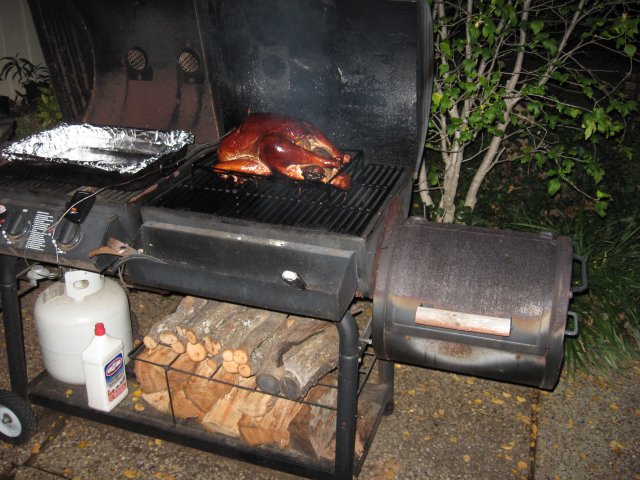
The Big Bird, yeah, we ate him. A hardwood smoked Turkey is the centerpiece of our Thanksgiving meal. This is the thirteenth or maybe fourteenth Turkey I have done for Thanksgiving. I usually buy a frozen Turkey five days before Thanksgiving. It will thaw in the refrigerator for three days, and spend two days in the brine before going into the smoker.
 I'll cook it directly in the smoke for two hours to get the smokiness in the meat, and then tent the whole bird to finish the cooking. I prepare a roasting pan by lining it with heavy duty foil. The Turkey is on a rack that fits the roasting pan. Then the Turkey and the rack go into the roasting pan.
 I have prepared a double sheet of heavy duty foil by folding the edges together, making it double wide. This will be the tent that goes over the top of the Turkey. At this point, in the picture above, the Turkey looks finished, but it will take another couple hours for the internal temperature to come up to a safe level.
 After putting the tent over the Turkey, I'll crimp all the edges closed to prevent the smoke from getting to the Turkey. At this point it has enough smoke, and only needs the heat.
 So all that is left is to watch the thermometer, and wait for it to get to 165 degrees Fahrenheit in the center of the breast meat. After the Turkey gets pulled out of the smoker it needs to rest for an hour or so to let the juices settle down.
I didn't get any table side pictures this year. Everything was too crazy once all the peeps got to the house. Last year's Turkey was perfect in the breast meat, but the dark meat was a little under done. This year the dark meat was perfect, but the breast meat was a little over done. You really can't get a whole Turkey totally perfect. To get the whole bird perfect you would need to quarter it, and cook each piece to temperature. Something to think about for next year...


I didn't get any table side pictures this year. Everything was too crazy once all the peeps got to the house. Last year's Turkey was perfect in the breast meat, but the dark meat was a little under done. This year the dark meat was perfect, but the breast meat was a little over done. You really can't get a whole Turkey totally perfect. To get the whole bird perfect you would need to quarter it, and cook each piece to temperature. Something to think about for next year...
Monday, November 28, 2011
Mystical Nom Noms
Sometimes all the right pieces fall into all the right places, and creates an epiphany state of mind. I found Kokopelli, the God of the Anasazi Indians, and He was right in front of me, literally. I could only paraphrase his description, so I'll leave this link if you want to learn His story, Kokopelli. He is the Fertility God, Prankster, Healer, and Storyteller.
 So, there is a long string of events that turned me this way and that way, goes around to Ancient Aliens, and back to Wingmakers, then over to Rosemeade Market, up to the Cosmic Paradigm, and ends in my own kitchen. I came close to the revelation a few times, but never put it all together until now. About four years ago I went to Red River, New Mexico, and I was pretty close there, but still far away.
The Wingmaker's book, Ancient Arrow starts with an experience of a woman who is the leader of an Indian tribe of Self-Knowers, known as the Chakobsa, later to be known as the Anasazi. I was within a stones throw of that land four years ago. I have been studying the spirit for a couple of decades now, and have had spiritual epiphanies before, but not of this magnitude, or coherence. You find bits, and pieces, little keys, pick them up, hold on to them.
So the word Anasazi has been festering in my brain for some time. Later I find Amaranth and Quinoa in a similar way, they are a couple of grain bearing plants that Indian cultures like the Inca, and Mayans were interested in. The Chakobsa were descendants of the Mayans. These Indians are still over there, one state over, and today the most predominant tribe in the area are the Hopi. They have been giving us clues, waiting for the paleface to wake up. I am kinda embarrassed that it took me this long to find Kokopelli.
So, we picked up some Indian art when we were in Red River, well on that trip anyway. They are ceramic tiles with hand painted figures on them. One has a Chile Ristra, one has the Sun God, with a Chile Ristra in front of it, and the last is Kokopelli. So, last week I am cleaning the house for Thanksgiving. Trying to be in a good mood, despite the huge amount of work we do before Thanksgiving, and I find these tiles. I think, these are cool, I should put them out for Thanksgiving, and they have remained behind the stove every since.

I have made a few posts about the spiritual significance of food, and how these relate to our physical well being, and mental acuity. The mysteries of life are not there to endlessly perplex us without solution, we are meant to figure these things out. One of my fist posts, Grains of the Gods, explored the history of Quinoa, and how it was very important to the Mayans. But I didn't see the spiritual significance. Another post, Red Chile Bread, I used Quinoa to make Red Chile Bread, which has other spiritually significant foods, Chile and Pine Nuts. Then the last piece of the spiritual culinary puzzle is the Anasazi Beans, Anasazi Bean Chili. I caught Kokopelli in the picture with the Chili, and I didn't know who he was at the time.

It wasn't until I ate all three of these foods together that I had this epiphany and found Kokopelli. It was a flight of contemplation that put pieces together that were accumulated over a 5 year span, that made me realize not just the spiritual significance of food, but also our physiological dependency on the right foods and the terrible sacrifice we make by eating the wrong foods. All things are tied together, and work together like Kokopelli is The All, One. We are all part of The All, we are all Kokopelli, together we are One.
Athletes eat to enhance their performance. High quality proteins, and potent vitamins increase their physical prowess. Great thinkers optimize their diets to boost their mental capacity with "brain foods". What if we can increase our spiritual awareness by eating foods that are optimal for that process? The Wingmaker's materials suggested that our DNA was damaged intentionally by a race of beings that wanted to use us as slaves (The Annunaki), and that the repair of the DNA would return latent, long lost powers that are mystical to us today, but should be as autonomic as breathing to us. Can we repair our DNA, and regain these lost powers, such as telepathy, telekinesis, mental healing, and teleportation?
There have been many people that have scratched at these ideas. David Wilcock believes that we are in the middle of an evolutionary cycle that will literally mutate us into a more evolved species. But it may be that we are returning to the way we once were. My epiphany was generated by lunch today. I had the last piece of my Red Chile Bread, a cup of Anasazi Bean Chili, and some homemade Pico de Gallo. I was musing about these ancient foods, and looking for Anasazi Glyphs on the interwebz when I found Kokopelli, and put all this together. The combination of Anasazi Beans and Quinoa is probably one of the most perfect foods for a human, but what if its more. Then there are the Chiles, and Pine Nuts in there also, all spiritually significant foods. What if its a catalyst that allows our spiritual awareness to exponentiate, or provides the raw materials to repair our "broken" DNA as the Wingmaker's materials have suggested?
Kokopelli knows, and he whispered it in my ear...

The Wingmaker's book, Ancient Arrow starts with an experience of a woman who is the leader of an Indian tribe of Self-Knowers, known as the Chakobsa, later to be known as the Anasazi. I was within a stones throw of that land four years ago. I have been studying the spirit for a couple of decades now, and have had spiritual epiphanies before, but not of this magnitude, or coherence. You find bits, and pieces, little keys, pick them up, hold on to them.
So the word Anasazi has been festering in my brain for some time. Later I find Amaranth and Quinoa in a similar way, they are a couple of grain bearing plants that Indian cultures like the Inca, and Mayans were interested in. The Chakobsa were descendants of the Mayans. These Indians are still over there, one state over, and today the most predominant tribe in the area are the Hopi. They have been giving us clues, waiting for the paleface to wake up. I am kinda embarrassed that it took me this long to find Kokopelli.
So, we picked up some Indian art when we were in Red River, well on that trip anyway. They are ceramic tiles with hand painted figures on them. One has a Chile Ristra, one has the Sun God, with a Chile Ristra in front of it, and the last is Kokopelli. So, last week I am cleaning the house for Thanksgiving. Trying to be in a good mood, despite the huge amount of work we do before Thanksgiving, and I find these tiles. I think, these are cool, I should put them out for Thanksgiving, and they have remained behind the stove every since.

I have made a few posts about the spiritual significance of food, and how these relate to our physical well being, and mental acuity. The mysteries of life are not there to endlessly perplex us without solution, we are meant to figure these things out. One of my fist posts, Grains of the Gods, explored the history of Quinoa, and how it was very important to the Mayans. But I didn't see the spiritual significance. Another post, Red Chile Bread, I used Quinoa to make Red Chile Bread, which has other spiritually significant foods, Chile and Pine Nuts. Then the last piece of the spiritual culinary puzzle is the Anasazi Beans, Anasazi Bean Chili. I caught Kokopelli in the picture with the Chili, and I didn't know who he was at the time.

It wasn't until I ate all three of these foods together that I had this epiphany and found Kokopelli. It was a flight of contemplation that put pieces together that were accumulated over a 5 year span, that made me realize not just the spiritual significance of food, but also our physiological dependency on the right foods and the terrible sacrifice we make by eating the wrong foods. All things are tied together, and work together like Kokopelli is The All, One. We are all part of The All, we are all Kokopelli, together we are One.
Athletes eat to enhance their performance. High quality proteins, and potent vitamins increase their physical prowess. Great thinkers optimize their diets to boost their mental capacity with "brain foods". What if we can increase our spiritual awareness by eating foods that are optimal for that process? The Wingmaker's materials suggested that our DNA was damaged intentionally by a race of beings that wanted to use us as slaves (The Annunaki), and that the repair of the DNA would return latent, long lost powers that are mystical to us today, but should be as autonomic as breathing to us. Can we repair our DNA, and regain these lost powers, such as telepathy, telekinesis, mental healing, and teleportation?
There have been many people that have scratched at these ideas. David Wilcock believes that we are in the middle of an evolutionary cycle that will literally mutate us into a more evolved species. But it may be that we are returning to the way we once were. My epiphany was generated by lunch today. I had the last piece of my Red Chile Bread, a cup of Anasazi Bean Chili, and some homemade Pico de Gallo. I was musing about these ancient foods, and looking for Anasazi Glyphs on the interwebz when I found Kokopelli, and put all this together. The combination of Anasazi Beans and Quinoa is probably one of the most perfect foods for a human, but what if its more. Then there are the Chiles, and Pine Nuts in there also, all spiritually significant foods. What if its a catalyst that allows our spiritual awareness to exponentiate, or provides the raw materials to repair our "broken" DNA as the Wingmaker's materials have suggested?
Kokopelli knows, and he whispered it in my ear...
Chile Harvest 2011
Last night was the first freeze of the season. So, yesterday I spent several hours picking the last of the fruit out of the garden. Root vegetables are not as susceptible as the fruits, so I still have some time before I have to harvest them. But the fruits will get frost damaged, so I picked the plants clean, taking ripe as well as immature fruit.
 This, if anything, is Christmas to me. The bountiful abundance of red and green chiles at the end of the harvest time, right before the fist freeze. Coincidentally, I am also hanging up Christmas lights today. See the connection there? Red and green lights? Red and green chiles handing off of Chile plants? I don't know if there is an actual connection there, but it sure seems apparent to me...
 My Habanero Chiles were planted in a shady spot this year, so there are relatively few ripe Habaneros. The green ones will sit around a while, until they turn orange, and then get dehydrated for use as a spice. I rarely use fresh Habaneros cooking, they is just too hot.

The red Cayenne Chiles will get washed, and go directly into the dehydrator. Cayenne Chile is probably my favorite spice. Again the green ones will have to sit around a while to mature, and turn red. They will turn in a week or so, and then get dehydrated.

The Jalapeno plants didn't do very well this year, and I don't know why. I only had a few that actually ripened, and most were very small. These green Jalapenos will get pickled. They are a constant table side condiment at my house. Nachos anyone?

The Anaheim Chiles usually get used like fresh vegetables, although can be dehydrated and used as a spice as well. They have a lower heat level, but more of that green Chile chlorophyll taste, so they go good in dishes that need some green chile, like Pepper Steak, or chile Rellanos. The red Anaheim Chiles usually get dehydrated and ground to become what is commonly know as Chile Powder, which is the base of Chili, and Enchilada sauce.

Then there are the Tomatoes, my poor, pitiful Tomato harvest this year. I have no explanation for why my Tomato harvest was so pitiful this year. One thing is reduced light, I have an Live Oak Tree which has been slowly usurping the light space in the back yard over the past decade. My garden hardly gets any afternoon sun anymore. I only had a few Roma tomatoes, and Better Bush Tomatoes, and they are all green. They will have to sit a while and ripen.
 In this little animation you can see how I load the dehydrator. The chiles go through a wash, and immediately into the dehydrator. It will take 8 to 12 hours to dehydrate them, and then they are preserved for the long haul. I have chiles that are 5 years old, still perfectly preserved.
 Then there are the trays of chiles that need to continue to ripen before we put them in the dehydrator. As these get ripe they will get a wash, and then take a ride in the dehydrator.

In addition to all the harvesting I also pulled out all the Christmas stuff, and got the house into Christmas mode. It usually takes a full day to get all of that done. So, altogether, it was a fruitful Sunday, lol, get it? Happy Jala'days! LOL! Chile-mas...


The red Cayenne Chiles will get washed, and go directly into the dehydrator. Cayenne Chile is probably my favorite spice. Again the green ones will have to sit around a while to mature, and turn red. They will turn in a week or so, and then get dehydrated.

The Jalapeno plants didn't do very well this year, and I don't know why. I only had a few that actually ripened, and most were very small. These green Jalapenos will get pickled. They are a constant table side condiment at my house. Nachos anyone?

The Anaheim Chiles usually get used like fresh vegetables, although can be dehydrated and used as a spice as well. They have a lower heat level, but more of that green Chile chlorophyll taste, so they go good in dishes that need some green chile, like Pepper Steak, or chile Rellanos. The red Anaheim Chiles usually get dehydrated and ground to become what is commonly know as Chile Powder, which is the base of Chili, and Enchilada sauce.

Then there are the Tomatoes, my poor, pitiful Tomato harvest this year. I have no explanation for why my Tomato harvest was so pitiful this year. One thing is reduced light, I have an Live Oak Tree which has been slowly usurping the light space in the back yard over the past decade. My garden hardly gets any afternoon sun anymore. I only had a few Roma tomatoes, and Better Bush Tomatoes, and they are all green. They will have to sit a while and ripen.


In addition to all the harvesting I also pulled out all the Christmas stuff, and got the house into Christmas mode. It usually takes a full day to get all of that done. So, altogether, it was a fruitful Sunday, lol, get it? Happy Jala'days! LOL! Chile-mas...

Anasazi Bean Chili
Funny looking cousin to the ubiquitous Pinto Bean is the Anasazi Bean. It has red and white splotches all over it. After they are cooked they are a dingy pink color. The name Anasazi refers to the Indian Tribe that cultivated these beans in the Four Corners region of the United States. Those of you who watch the Ancient Aliens series may also be familiar with the Anasazi because of their cave drawings of Ancient Astronauts. Two things that make these people interesting to me, Beans and Ancient Astronauts...


 OK, back to the Chili. I soak the dry Anasazi beans for about 6 to 8 hours in 4 cups of Vitalized Water. This allows the beans to start to sprout right before cooking them. Soaking the beans first is supposed to help alleviate the bean music afterwards. Beans like to be cooked low and slow, so we are starting the heat at about 30 percent, and just let the beans take their time, don't rush them. Once they come up to a boil I add 2 teaspoons of Sea Salt, reduce the heat to about 15 percent, and let them simmer for an hour. Meanwhile dice some White Onion, Garlic, and Chiles. Quantities are up to you. I like less Onion, and more garlic and Chile. I harvested Chiles yesterday, so I have a plentiful variety of Chiles for my Chili. I wound up using 2 large, fresh Cayenne Chiles, and 1 large, red Anaheim Chile, so its not super spicy. Then I added a couple of tablespoons of Caldo de Pollo to add to the flavor. Mix the Chili together thoroughly, and let it simmer for another hour.
 I have some leftover Ham from Thanksgiving that I added in the serving bowl, and a few Scallions on top. Anasazi Bean chili is Mui Delicioso, uh that means Nomlishious for you Gringos...
Anasazi Indian cave dwellings

Anasazi Indian Ancient Alien Petroglyphs

There is some information about the Anasazi Indians here...


Subscribe to:
Posts (Atom)