
Sunday, January 24, 2016
Jalapeno Cheeze Burger
This is why I like my Baby Q. I can make burgers like this in 10 minutes. This time I added Black Pepper, granulated Garlic, and Sea Salt in the burger. Grill on high, just a few minutes on each side. The bread is griddled Sourdough, from Village Baking Co., in butter, then sprinkled with granulated Garlic, and Sea Salt. There is Jalapeno Mustard on both sides of the Sourdough, with thin sliced white Onion on bottom, and thin sliced fresh Jalapeno on top with the Cheddar. Its a Texas thing...


Saturday, July 4, 2015
Peach Glazed Spare Ribs
These Spare Ribs have the name of another location. Well, I think I need to make them my own, and change that name to Peach Glazed Texas Spare Ribs. This is probably the fanciest Spare Rib dinner I have evar made. I spent $4 on the meat, and spent nearly 5 hours preparing it. Salty, spicy, sweet, tart, but it sure is Nomlishous. Harley is beside himself trying to get a taste, puppy tease...

Were going to start with the regular, off the shelf, vacuum packed, other city name, spare ribs. Peel the silver skin off the inside, then I am going to use my usual rub which is Tony Chachere's, and fresh cracked Black Pepper, but a light dusting. So this is going to start like the BBQ I usually make.
 I am lightly dusting both sides. I typically don't make ribs, and would much rather make a pork butt. The original idea for this was a Peach Glazed Pork Butt. But, heh, when I was at the store today spare ribs were only $0.99 a pound, so I changed course there. The same concept would apply to the Pork Butt. In the meantime I have got a Charcoal, and Hickory fire going in the Pit.
 Next we're going to get the Ribs into the Pit. My Pit runs about 275 degrees Fahrenheit. Its just where it likes to go. What matters is consistent heat, and not so much the precise temperature. Ribs want long, and low, and 275F is fairly low. If we brought the temperature down it would take a lot longer for the temperature to penetrate the ribs. I want to eat it tonight, and not tomorrow morning.
 Now, while the ribs are smoking, we're going to start the Peach Glaze. This is the Apex of Peach Season in Texas. I have four large, small stone, freestone, Peaches from Rosemeade Market. They aren't overly sweet, and have a nice tartness. There is only a small time of the year you can get Peaches this good, and that is now.
 There is another place to get peaches around Dallas, and that is Ham Orchard's. These aren't as good as Ham's, but the have a little more tartness. The Peaches from Ham's are perfectly ripe right now, and are best eaten fresh.
 Next I'll break the seeds out of the Peaches, and quarter them. Then they are going through the Juiceman, so I can have the Peach juice, the base of the Peach Glaze. This is going to be a very basic Peach Sauce, if I cooked it a little longer, and cool it, we would have Peach Jelly.
 I would up with around three cups of Peach juice. The juice comes out of the Juiceman rather frothy, but the froth will cook off, and leave us with a mainly clear liquid. Since the Peaches are kinda tart, I'm going to add some Honey for sweetness, and a few shakes of salt just to brighten the flavor a little bit. Adding just a little salt to fruit is something I never agreed with, until I tried it, and it makes a difference.
 This is a compote, sans the fiber, or if you prefer, a jelly recipe. Serve it hot, and its a glaze, cool it, and let it solidify, and it will be jelly. This is a true Holiday preparation, because I am into it about four hours now, but the rewards will be awesome. I may have to make something like this at Thanksgiving. Now that the Peach Sauce is started, I need to check on the Spare Ribs.
 OK, now we will ping back to the glaze. The froth on the Peach Juice has a tendency to boil over, so it needs constant attention, until it starts to reduce, and the froth gets cooked off. One the froth is cooked off, and the Glaze starts forming you can turn the heat down to a slow simmer, and let it get nomlishous.
 Bing! Three hours are up, and its time to take the Spare Ribs out of the smoker. Man, they look good.
 I gave them a taste, and they are salty, spicy, savory, and we're going to marry that with the tart, sweet Peach Glaze. This is gonna be great. I'll tent the Spare ribs with plenty of foil, and put them in a really slow oven, around 170F, so the ribs can re-incorporate their juices, and can wait indefinitely, until the Peach Glaze is done.
 I have to add a video of the Peach Glaze simmering here. It looks very good by itself.
Here is a shot of the assembly. It has been a long time coming, but well worth the effort...
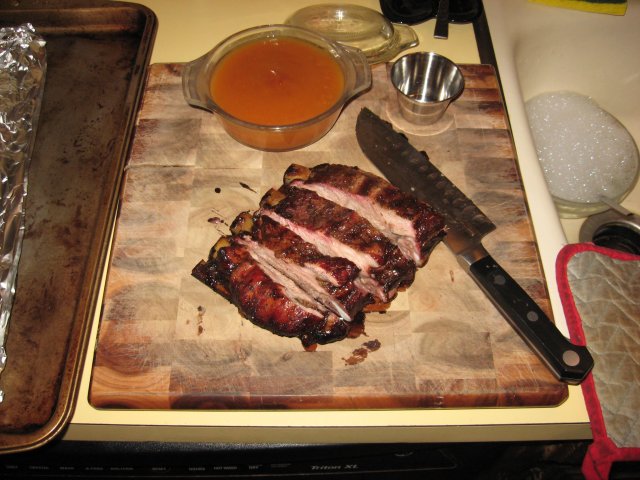

Were going to start with the regular, off the shelf, vacuum packed, other city name, spare ribs. Peel the silver skin off the inside, then I am going to use my usual rub which is Tony Chachere's, and fresh cracked Black Pepper, but a light dusting. So this is going to start like the BBQ I usually make.


Chile Garlic Shrimp
We went to get Pho at Photai, near Super H-Mart yesterday. I had some leftovers, and needed to add a little something to them. Also had some raw, shell on, Texas farm raised Shrimp, and have been experimenting with the shell on Shrimp lately. So this is a pan seared version of these Shrimp.
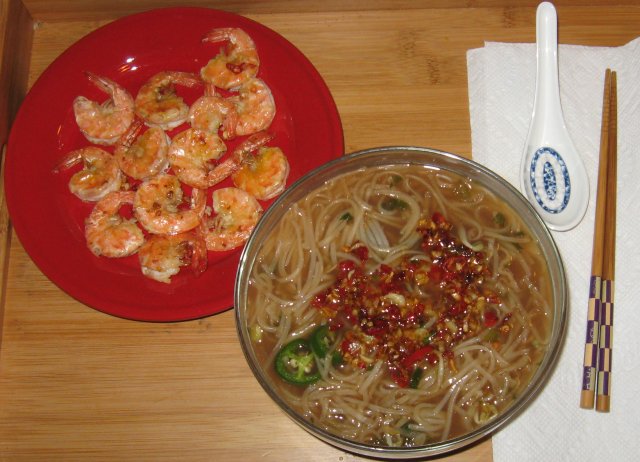 The shell on Shrimp are whole except for the heads. So they need to be de-veined, and marinated before cooking. We'll slice them down the back and rinse out the vein with a dribble of cold water, dry them, and put them in a bowl to be marinated.
 I have some fresh Cayenne Chiles, and Garlic to dice up really fine. Then add some Sea Salt, and Olive oil. Mix them together, while trying to work the marinade between the shell, and the meat.
 In the meanwhile, I'm going to get a skillet hot over medium heat. The leftover Pho needs a little attending to also. I'll add some Fish Sauce, and water to get a little more liquid into the Pho because the noodles soaked up some of the broth, and I though it needed a little more broth. Then heat the leftover noodles up in the microwave.
 The Chile Garlic Shrimp then go into the hot skillet for a quick sear on each side. I tried to get all the Chile, and Garlic in the skillet as well. When the Shrimp turn pink they go on to a platter next to the Pho, and the remaining Chile, and Garlic go into the Pho. TexViet nom-nom-lishousness...


Monday, April 27, 2015
Beef Jerky
Been thinking about this one for a while. Beef Jerky is a good traveling food. I find myself relying on quick snacks more as I have less time to be in the kitchen. This recipe is relatively simple, marinate the beef then "cook" it with a long, low temperature process. Easy right?
 I'm going to start with a London Broil, which is the Top Round cut of Beef. This cut has the grain in a longitudinal direction, so I can make the slices across the grain. The Steak is 1.67 pounds to start.
 After I got the Steak home from the store I put it in the freezer for a couple hours to get it nearly frozen. This helps the slicing process. I looking to get about a quarter inch slices.
 This cut was trimmed nicely by the butcher, and there is little fat within the meat, perfect for Beef Jerky. Next is the marinade.
 I started with a base of Soy Sauce, and Worcestershire Sauce, a half cup of each. Then for the heat I added a tablespoon of Melinda's Naga Jolokia Sauce, and eight Cayenne Chiles, so this one should be pretty hot. Then round off the spice with a tablespoon of Honey, and some Black Pepper last.
 All the marinade ingredients go into a gallon size ziplock bag. I ground the Cayenne Chiles with a Coffee grinder. Then we can start adding the Steak slices.
 I coat each slice as it is added to the marinade. We want to get every piece coated evenly, so none miss out on the fiery marinade.
 Once all the Steak is in the marinade push the extra air out of the bag, and seal it. This will marinate in the refrigerator for a day. Then we'll put it in the food dehydrator tomorrow.
 I added the strips of Steak in one layer per rack. I didn't think I would have enough room in the food dehydrator, but I probably could have done twice as much Steak, about three pounds. I ran the food dehydrator for around 12 hours, until the Steak strips seemed dried to what I think of as Beef Jerky. Its good, and has a lingering burn of those Naga Jolokia Chiles. I started with about 26 ounces of fresh Steak, and with finished weight is about 10 ounces, so the Beef lost about a pound of water.
Wednesday, March 18, 2015
Shit on a Shingle
I make smoked pork butts which I then put in the crockpot over night. This makes a smoky Au Jus which I then used to make a gravy. This one has Garlic, Onions, Mushrooms, Red Chile Flakes, and a Cornstarch thickener. I had the Shit on a Shingle concept in my mind when I was building the gravy. So there is two toasted slices of multi-grain toast, two fried eggs, the Au Jus gravy, and some of the Pork, almost as a garnish, on top. This is the kinda breakfast you need for doing hard labor.
 Making gravy, or a pan sauce is easy when you start with meat drippings, or Au Jus. For a clear gravy use Cornstarch, or for a more traditional brown gravy use flour. Watch the salt, usually the meat is seasoned with salt, and the pan drippings will be salty already, and concentrate the saltiness as it reduces, so there is not really a need for extra salt. But its OK to go crazy with the extra flavorings like Garlic, Onion, Mushrooms, Red Chile...

Saturday, February 28, 2015
Chipotle Kimchi
Got a new toy, a Chile grinder made from Iron wood. My mother found it while traveling through New Mexico, Santa Fe I think, and thought I could use it. This Tex-Asian Chipotle Kimchi has Chipotles that were ground with this unique Chile grinder.
 I break a dried red Jalapeno into pieces, then take the red Chile flesh, and put it in the grinder. This lets the seeds, and membranes fall out, reducing the heat. Hand ground Chile has better texture in the Kimchi. I have leftover Brine, Fish Sauce, Ginger, Garlic, and the Chipotles to add to the Kimchi Sauce, I used the food processor to make the sauce, but it might be better to use a motor and pestle.
 I ate some as I was assembling it, and its great already. With another week of fermentation it will be perfect. Can't wait till Friday. Totally Nomlishous...
Sunday, October 26, 2014
2014 Chiles
This year I planted Bhut Jolokias, and they are prolific. The plants are about twice as big as the other Chile plants. Its kind of a problem because they hog up all the light, and the other Chiles aren't getting enough.
 They are also exceptionally hot, about a million Scovilles. They are about three times as hot as a regular orange Habanero, or twice as hot as a Red Savina Habanero. I am going to make a sauce with them when I have a larger amount of ripe Bhut Jolokias (Ghost Pepper), but at the moment I only have a few ripe ones. So I'll dehydrate them so I can use them as a spice, then later rehydrate them when I go to make sauce.
 Like I said before the plants are prolific, over six feet tall, and the main stems are like two inches in diameter. Like other hot Chiles they really didn't start to grow well until the very hottest part of the Summer. Now they are producing Chiles like crazy. The Habaneros are behind the Bhut Jolokias, can't even see them.
 The Fall brings cooler weather, and less light, and this causes the Chiles to fruit like crazy. This Serrano Chile is getting overladen with fruit, causing the stems to bend over, and sometimes break. The red and green Serrano Chiles remind me of Christmas lights. There have been some years where the Chiles have lasted until Christmas.
 There are lots of green Cayenne Chiles right now. As they turn red I pick them, and put them in the food dehydrator. The Cayenne Chiles are my main staple Chile that I use in everything. The Cayenne can be picked green, then let it sit around a while, and it will ripen, and turn red.
 Sometimes the Bhut Jolokias are hard to see because they are exactly the same color as the plants. There are several in this picture. When they ripen, they turn a bright red color, and stand out. I am not sure what to do with them at this point, make sauce for sure, but for something like Chili they may be too hot.
 Here the Cayenne Chile plants are overladen, and bent over. As I harvest the Chiles they spring back up.
Subscribe to:
Posts (Atom)