This year I planted Bhut Jolokias, and they are prolific. The plants are about twice as big as the other Chile plants. Its kind of a problem because they hog up all the light, and the other Chiles aren't getting enough.
They are also exceptionally hot, about a million Scovilles. They are about three times as hot as a regular orange Habanero, or twice as hot as a Red Savina Habanero. I am going to make a sauce with them when I have a larger amount of ripe Bhut Jolokias (Ghost Pepper), but at the moment I only have a few ripe ones. So I'll dehydrate them so I can use them as a spice, then later rehydrate them when I go to make sauce.
Like I said before the plants are prolific, over six feet tall, and the main stems are like two inches in diameter. Like other hot Chiles they really didn't start to grow well until the very hottest part of the Summer. Now they are producing Chiles like crazy. The Habaneros are behind the Bhut Jolokias, can't even see them.
The Fall brings cooler weather, and less light, and this causes the Chiles to fruit like crazy. This Serrano Chile is getting overladen with fruit, causing the stems to bend over, and sometimes break. The red and green Serrano Chiles remind me of Christmas lights. There have been some years where the Chiles have lasted until Christmas.
There are lots of green Cayenne Chiles right now. As they turn red I pick them, and put them in the food dehydrator. The Cayenne Chiles are my main staple Chile that I use in everything. The Cayenne can be picked green, then let it sit around a while, and it will ripen, and turn red.
Sometimes the Bhut Jolokias are hard to see because they are exactly the same color as the plants. There are several in this picture. When they ripen, they turn a bright red color, and stand out. I am not sure what to do with them at this point, make sauce for sure, but for something like Chili they may be too hot.
Here the Cayenne Chile plants are overladen, and bent over. As I harvest the Chiles they spring back up.
Science and Spirit come together to give us a whole-istic view of the world we live on...
Sunday, October 26, 2014
Sunday, October 5, 2014
Daikon Kimchi
Another interesting item I picked up at Carrollton Plaza are these Daikon Radishes. I'm planning to grow Daikon Radishes this year. Daikon is a popular ingredient in Kimchi. This is a root vegetable Kimchi.
Daikon Radish is a relatively mild Radish, and can use the help of sharp ingredients This one has Garlic, Onion, Cayenne Chile, Fish Sauce, and Carrots. I got some organic carrots at Rosemeade Market which are Kaleidoscope Carrots, many colors.
Daikon is a very large root vegetable, and I'll dice it up into bite sized pieces.
Same with the Carrots. The Garlic gets smashed, and the Cayenne Chiles are broke into pieces.
Then mix all the components together, and put them in the fermenting jar. This goes together like the Sour Giardinira that I made last March, except this has Fish Sauce in it. I'll add about a cup of the Fish Sauce, and then top it off with five percent salinity brine. Like with the other fermented vegetable mixes I make, this one will sit on the counter, at room temperature until the ferment sizzles, then will go to cure in the refrigerator.
Kosher Dill Pickles
I was shopping at Carrollton Plaza on Saturday and came across some Persian Cucumbers. I've never seen this variety before. They are similar to English Cucumbers, but smaller like a pickling Cucumber. I've had a request recently to make some Kosher Dill Pickles, so why not try it with these Persian Cucumbers.
The Persian Cucumbers are very uniform, and about 5 inches long. I have a container that is perfect for them. I also added some regular Pickling Cucumbers to make up the extra space at the top of the container. I'm using a one quart ziploc container filled with water to hold the Cucumbers down in the brine. I started this process by making three quarts of five percent salinity Brine with Sea Salt, and Vitalized Water.
Then I let the Brine cool down to room temperature. We don't want to cook these beautiful Persian Cucumbers at all. Kosher refers to a particular style of Pickle which is cured with Garlic, and Dill, and not necessarily Kosher in the Rabbinic Traditions. It is very popular in Deli cuisine, and is rumored to have originated in New York. I love getting a big Ruben sandwich with Kosher Dill Pickles on the side.
We need to soak the Cucumbers in fresh water for a while to loosen any dirt that may be on them. Then rub the outside of each Cucumber to remove the dirt. I'll trim the Stem, and Blossom ends of the Cucumbers to hasten the osmosis process. The cells of the Cucumber will work to balance the salinity of the Brine with their own internal salinity. This draws the flavoring into the cells of the Cucumbers.
Garlic is the major flavoring that we are concerned with, and I am going to use a whole head of Garlic for this batch of Pickles. Garlic has anti-biotic properties, and is part of what makes these Pickles Kosher. The other part that makes these pickles Kosher is Salt. The Brine kills harmful bacteria.
Dill is the second flavoring we are concerned with. I'm going to start filling the Pickling Vessel with a big bunch of Dill, which also has anti-biotic properties. So it not only tastes good, its also good for you. I'm also going to throw in a handful of Pickling Spice to give it that familiar Pickle flavor. I'm also going to throw in a couple whole Cayenne Chiles, to give them a little heat.
Then I'll start stacking in the Cucumbers, alternating directions, and adding crushed cloves of Garlic as I go. These will sit on the kitchen counter for around a week, until the brine "sizzles". What I mean by sizzle is the brine will release a significant amount of Carbon Dioxide bubbles when agitated. This is how you know the Lactobacillus Culture is highly active, making the Lactic Acid that makes the Pickles sour. After the brine reaches the "sizzling" state then the Pickles can be refrigerated for the curing stage where the Lactobacillus goes dormant, the flavors meld, and mellow, and the Pickles reach the state of Umami, or ultra-nomlishousness...
The Persian Cucumbers are very uniform, and about 5 inches long. I have a container that is perfect for them. I also added some regular Pickling Cucumbers to make up the extra space at the top of the container. I'm using a one quart ziploc container filled with water to hold the Cucumbers down in the brine. I started this process by making three quarts of five percent salinity Brine with Sea Salt, and Vitalized Water.
Then I let the Brine cool down to room temperature. We don't want to cook these beautiful Persian Cucumbers at all. Kosher refers to a particular style of Pickle which is cured with Garlic, and Dill, and not necessarily Kosher in the Rabbinic Traditions. It is very popular in Deli cuisine, and is rumored to have originated in New York. I love getting a big Ruben sandwich with Kosher Dill Pickles on the side.
We need to soak the Cucumbers in fresh water for a while to loosen any dirt that may be on them. Then rub the outside of each Cucumber to remove the dirt. I'll trim the Stem, and Blossom ends of the Cucumbers to hasten the osmosis process. The cells of the Cucumber will work to balance the salinity of the Brine with their own internal salinity. This draws the flavoring into the cells of the Cucumbers.
Garlic is the major flavoring that we are concerned with, and I am going to use a whole head of Garlic for this batch of Pickles. Garlic has anti-biotic properties, and is part of what makes these Pickles Kosher. The other part that makes these pickles Kosher is Salt. The Brine kills harmful bacteria.
Dill is the second flavoring we are concerned with. I'm going to start filling the Pickling Vessel with a big bunch of Dill, which also has anti-biotic properties. So it not only tastes good, its also good for you. I'm also going to throw in a handful of Pickling Spice to give it that familiar Pickle flavor. I'm also going to throw in a couple whole Cayenne Chiles, to give them a little heat.
Then I'll start stacking in the Cucumbers, alternating directions, and adding crushed cloves of Garlic as I go. These will sit on the kitchen counter for around a week, until the brine "sizzles". What I mean by sizzle is the brine will release a significant amount of Carbon Dioxide bubbles when agitated. This is how you know the Lactobacillus Culture is highly active, making the Lactic Acid that makes the Pickles sour. After the brine reaches the "sizzling" state then the Pickles can be refrigerated for the curing stage where the Lactobacillus goes dormant, the flavors meld, and mellow, and the Pickles reach the state of Umami, or ultra-nomlishousness...
Wednesday, October 1, 2014
Kimchi 4
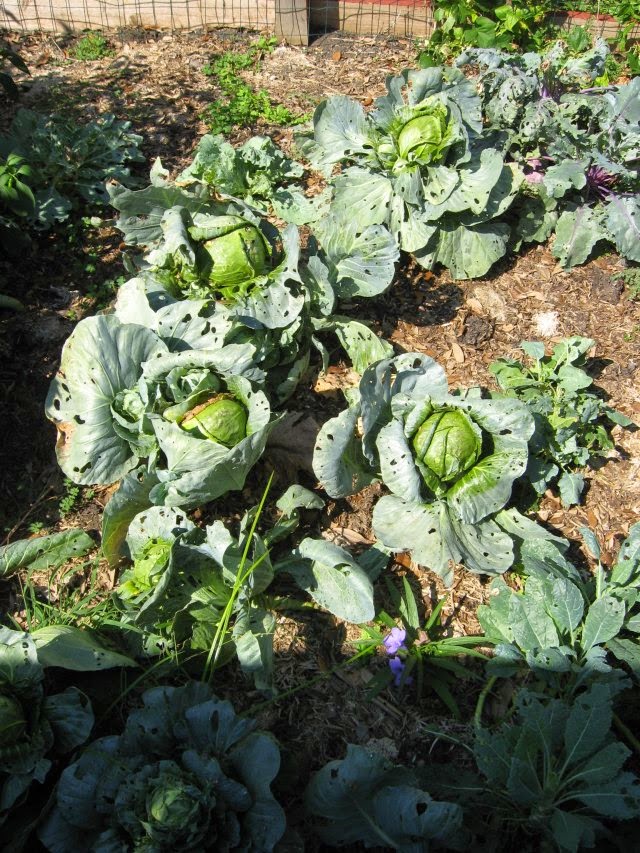
Part of getting the right nutrition is letting the Earth know what you need, then it can provide it. This is the whole reason for growing your own vegetables.When you work the Earth, put your hands in the soil you are making a connection with the Earth, and all the things that live in it. Which, yes, includes a plethora of insects, and micro-organisms. It is very important that they know you. They will work for you if you let them. This is my latest batch of Kimchi, made with homegrown Cabbage.
I've been working this garden for 12 years, so it knows me well. I am delighted to have a vast insect culture, and large healthy Earth Worms, so I know that I have a great micro-organism culture, and healthy organic soil. I don't use pesticides, or chemical fertilizers, but there is a distinct lack of pest insects, such as Fire Ants. This is because of the thriving beneficial insect culture. I let Wasps stay in my garden because they feed on Cabbage Worms. This is where Organic Gardening differs from modern Gardening.
Organic plants are not as pretty as plants treated with pesticides, and chemical fertilizers, but the difference is the rich abundance of natural enzymes, and beneficial micro-organisms. Organic plants provide you with these beneficial micro-organisms, especially if you work the Earth, and grow your own. These are things that are not available in processed food, or even commercially raised food. Its the difference between health, and superlative health.
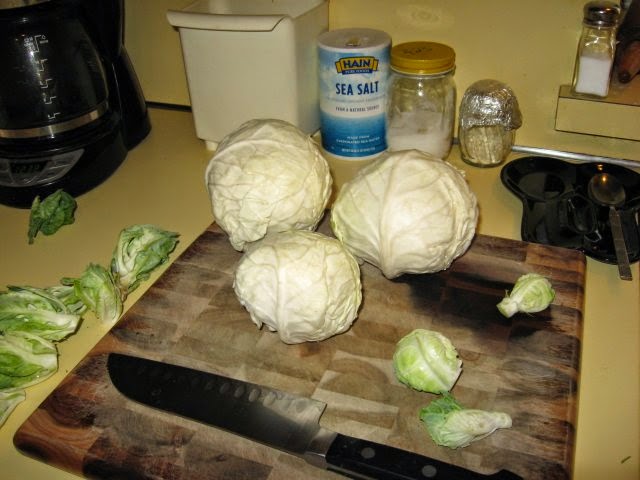
The neat thing about Cabbage is you can lop off the top of the plant, and leave the root, and it will grow more cabbages. Free Food! Whoo Hoo! Now these plants are kinda chewed, which is OK. We can peel back the layers, to reveal the dense heads. Don't be afraid of the insects, they are there to help.
There are many insects living on, and around the Cabbage. Pill bugs, Spiders, a few Cabbage Worms, and the like. Just peel them away with the outer layers of the Cabbage. I try to do this in or around the Garden to keep the insects in close proximity to their home. The outer leaves are rich with nutrients, and can be composted back into the garden.
As you peel back they layers you will also find some more Cabbage Sprouts, which grow like Brussels Sprouts. Cabbage, and Brussels Sprouts are closely related, and are probably cultivars of a similar ancestor. I'm growing Brussels Sprouts as well, and will probably do something like Kimchi with them.
After I get the Cabbages cleaned up, I will chop them, and soak the shredded Cabbage in a 5% Salinity Brine for several days. When I am ready to make the Kimchi I'll drain the Cabbage, reserving the Brine, and make a Chile Paste for the Kimchi with dry Chiles, Garlic, Ginger, Fish Sauce, and some of the Brine. This time I used Pasilla Chiles, and it gives the Kimchi a brownish color. Kinda weird for Kimchi, but it tastes great, and has superior nutritional value because of the old, yet advanced technique of organic gardening, mixed with Lacto-Fermentation. Turns out what is old is right, and modern techniques leave something to be desired.
I've been working this garden for 12 years, so it knows me well. I am delighted to have a vast insect culture, and large healthy Earth Worms, so I know that I have a great micro-organism culture, and healthy organic soil. I don't use pesticides, or chemical fertilizers, but there is a distinct lack of pest insects, such as Fire Ants. This is because of the thriving beneficial insect culture. I let Wasps stay in my garden because they feed on Cabbage Worms. This is where Organic Gardening differs from modern Gardening.
Organic plants are not as pretty as plants treated with pesticides, and chemical fertilizers, but the difference is the rich abundance of natural enzymes, and beneficial micro-organisms. Organic plants provide you with these beneficial micro-organisms, especially if you work the Earth, and grow your own. These are things that are not available in processed food, or even commercially raised food. Its the difference between health, and superlative health.
The neat thing about Cabbage is you can lop off the top of the plant, and leave the root, and it will grow more cabbages. Free Food! Whoo Hoo! Now these plants are kinda chewed, which is OK. We can peel back the layers, to reveal the dense heads. Don't be afraid of the insects, they are there to help.
There are many insects living on, and around the Cabbage. Pill bugs, Spiders, a few Cabbage Worms, and the like. Just peel them away with the outer layers of the Cabbage. I try to do this in or around the Garden to keep the insects in close proximity to their home. The outer leaves are rich with nutrients, and can be composted back into the garden.
As you peel back they layers you will also find some more Cabbage Sprouts, which grow like Brussels Sprouts. Cabbage, and Brussels Sprouts are closely related, and are probably cultivars of a similar ancestor. I'm growing Brussels Sprouts as well, and will probably do something like Kimchi with them.
After I get the Cabbages cleaned up, I will chop them, and soak the shredded Cabbage in a 5% Salinity Brine for several days. When I am ready to make the Kimchi I'll drain the Cabbage, reserving the Brine, and make a Chile Paste for the Kimchi with dry Chiles, Garlic, Ginger, Fish Sauce, and some of the Brine. This time I used Pasilla Chiles, and it gives the Kimchi a brownish color. Kinda weird for Kimchi, but it tastes great, and has superior nutritional value because of the old, yet advanced technique of organic gardening, mixed with Lacto-Fermentation. Turns out what is old is right, and modern techniques leave something to be desired.
Sunday, September 21, 2014
Flank Steak Tacos
Flank Steak is a really flavorful cut of beef. Season it, then chargrill it, and its the best cut of beef you can eat. I picked up some Hatch Chiles at Rosemeade Market today, along with some Purple Cabbage, and made a slaw for these Flank Steak Tacos. I had a piece of leftover Flank Steak that was the right chunk of meat at the right time. I had been working Saturday morning, and got really hungry, then threw this together in like 10 minutes. I used Melinda's Red Savina Habanero Sauce as the Taco Sauce. I like Melinda's Sauces because they are flavorful, and not just hot.
Monday, September 1, 2014
Potato and Egg Breakfast Tacos
Possibly my favorite breakfast food is Potato, and Egg breakfast Tacos. Simple, but hearty, they are not overcomplicated with too many ingredients. I don't want that heavy, need a nap feeling after breakfast, gotz work to do. The thing that make mine so good is butter, everything is cooked in butter.
Usually I used shredded Hash Browns as the Potato part. This time I have a leftover baked Potato. Take a tablespoon of butter, in a skillet, and brown the diced baked Potato for a few minutes before adding two scrambled eggs. The tortillas will cook in a small amount of butter on a Cast Iron Griddle.
Cooking the Tortillas gives them more flavor, but were not looking to cook them until they are crispy. The Butter, and Sea Salt also enhance the flavor of the Tortillas. When the Potatoes have some color dump the scrambled Eggs into the skillet with the Potatoes.
When everything is cooked assemble them on a serving plate, and I serve them with my Loco Casa Salsa, or Crazy House Sauce, which is my usual homemade Salsa with Cayenne, Jalapeno, Cumin, and Sea Salt.
Usually I used shredded Hash Browns as the Potato part. This time I have a leftover baked Potato. Take a tablespoon of butter, in a skillet, and brown the diced baked Potato for a few minutes before adding two scrambled eggs. The tortillas will cook in a small amount of butter on a Cast Iron Griddle.
Cooking the Tortillas gives them more flavor, but were not looking to cook them until they are crispy. The Butter, and Sea Salt also enhance the flavor of the Tortillas. When the Potatoes have some color dump the scrambled Eggs into the skillet with the Potatoes.
When everything is cooked assemble them on a serving plate, and I serve them with my Loco Casa Salsa, or Crazy House Sauce, which is my usual homemade Salsa with Cayenne, Jalapeno, Cumin, and Sea Salt.
Sunday, August 31, 2014
Fried Chicken Soft Tacos
I'm gonna catch hell for this one. Taking a southern staple, and doing the Tex/Asian Fusion on it. Fried Chicken is ubiquitous in the South, so lets make Tacos with it...
I make my Fried Chicken a little different than the traditional way. I start with a pan of Bacon, and render the fat to fry the Chicken. No flour, or coatings on the Chicken other that Tony Chachere's, and Black Pepper. Start the Chicken skin side down over medium heat for 20 minutes. Then flip the Chicken for 20 minutes on the other side. Finally into a 425 F over for another 10 minutes. The skin is brown and crispy to add a little krunch to the Soft Tacos.
For the salad portion I used shredded Iceburg Lettuce, chopped Cilantro, and some slice red Onions marinated in Mirin. I only recently started using Mirin, and its the Asian flair in the Soft Tacos. The Salsa I am having with the Soft Tacos has Cayenne Chile, Jalapeno Chile, White Onion, Cumin, and Sea Salt in it. I usually roast the Jalapeno Chiles before making the Salsa. this time I didn't.
I make my Fried Chicken a little different than the traditional way. I start with a pan of Bacon, and render the fat to fry the Chicken. No flour, or coatings on the Chicken other that Tony Chachere's, and Black Pepper. Start the Chicken skin side down over medium heat for 20 minutes. Then flip the Chicken for 20 minutes on the other side. Finally into a 425 F over for another 10 minutes. The skin is brown and crispy to add a little krunch to the Soft Tacos.
For the salad portion I used shredded Iceburg Lettuce, chopped Cilantro, and some slice red Onions marinated in Mirin. I only recently started using Mirin, and its the Asian flair in the Soft Tacos. The Salsa I am having with the Soft Tacos has Cayenne Chile, Jalapeno Chile, White Onion, Cumin, and Sea Salt in it. I usually roast the Jalapeno Chiles before making the Salsa. this time I didn't.
Subscribe to:
Posts (Atom)