
Sunday, July 6, 2014
Bhut Jolokia
This is the first Bhut Jolokia I harvested this year. The plants are prolific, and very large. Its a unique Chile, that's for sure. I'm feeling Barbeque tonight, with the special "Burn your face off" sauce. There are a couple Serrano Chiles there for comparison.

Tuesday, June 17, 2014
Spring Veggies
I'm starting to harvest some Veggies from the Spring Garden now. I've got my first Cucumber of the year today. The Tomatoes look great, and this year have no critter damage because I have the garden surrounded by fencing, and have all the holes covered. Harley can't get in to graze at will. I'll let him in every once in a while, but not unsupervised. My green salad today will have Cucumber, Tomato, and Parsley fresh out of the garden.

Sunday, June 1, 2014
Spring Garden 2014 part 2
I'm finally starting to get some vegetables out of the Spring garden.

These are Better Bush II Tomatoes. I'm letting the Tomatoes sprawl on the ground this year.

Here you can see the Cilantro has bolted, falling all over everything.

These are Sugar Snap Peas, and a really good straight off the vine.

These are one of the varieties of bean I planted, don't know which is what when they are green.

There is Harley over by the Tomato Patch.

Here are a couple Purple Kohlrabi. They might be the weirdest vegetable I grow.

This is a narrow leaf Kale, called Lacinato Kale.

Here is the Cabbage Patch, there are some heads up too about four inches.

This is a Bhut Jolokia Chile Plant, burn your face off hot...

This one is a Cayenne Chile Plant, with some young Chiles.

Finally this is a flowering Lavender, with its long whispy flowers.
Beer Braised Beef Shanks
Mmmm, totally nomlishous Beer Braised Beef Shanks... There are those who love teh Beefz. Shanks are leg slices, a tough cut with lots of connective tissue, They need to be slow cookered to be good. I'm gonna add lots of aromatic vegetables to bring the the favor up.
 This is a cheap cut of beef. It has to be spiced up, then cooked low and slow to bring out the goodness of the cut. This is something that is familiar to me, take a cheap cut of meat , and make it nomlishous...
 There is a lot of marbling, and connective tissue in a leg shank. This makes it flavorful, but it has to be cooked right to be eatable. If you were to grill these pieces they would be very tough. They need to be stewed. They need to be cooked low and slow to cook down the connective tissue, and bone marrow...
 This relatively boring cut of meat needs a lot of seasoning. I use Tony Chachere's Season Salt, and Black Pepper to make it Mo Betta. Let the seasoning pull the moisture out of the meat for about half an hour.
 Then we'll add flour to soak up the meat juices, and make a Roux for the Stew part. Braised meats are stewed, and that is the good part. Think of Pot Roast, or Salisbury Steak, the Beef Shanks are going to be stewed in Beer and Vegetables to make a savory main dish.
 First, we are going to fry the Beef Shanks in Bacon Fat. Get a nice sear on both sides over high beat. This gives the flour the chance to absorb the fat from the Beef, brown the flour, and make the Roux.
 Then we are going to add Onion, Tomato, Jalapeno, and Garlic for the Vegetable part. You can add all the vegetation you want. I like southwestern flavors so I'm going to add Salsa, basically.
 Al of this goes into the pan, around the Beef Shanks to give it a chance to cook. This will stew a while so don't worry about cooking the Vegetables by themselves much.
 I'll add everything but the Garlic to start stewing. The Garlic goes in last, right before we add the stewing liquid.
 This is really starting to look good now, and smell good. What could possibly make it better? Beer!
 I'm adding a 16 ounce can of Ale to be the stewing liquid. Reduce the heat to simmer, cover, and prepare for nomlishousness...
 This is the stewing part where everything comes together. I'm gonna lets this simmer for around half an hour.
 The meat is slow cookered, extra tender. The flour has incorporated into the liquid making a spicy gravy.
 I made some Egg Noodles for the Gravy to stick to. Sliced the Beef Shanks into thin strips to make them extra tender. This is Sunday Dinner Prima Vera. Om nom nom nom...
Tuesday, May 13, 2014
German Potato Salad
Looking for a zesty alternative to French Fries with my burger this week, I decided to make a German Potato Salad. It took a while to find exactly what I wanted to do, as there are many Potato Salad recipes. I knew I wanted a non-mayonnaise Potato Salad, but didn't know where to go after that. It turns out that I used a Herbaceous Vinaigrette that has Pork Fat, Rice Wine Vinegar, and lots of Dill.
 Its a salad so a Vinaigrette seems appropriate, and the Dill makes it fresh. But how many salads start out with a pan of Bacon? It looks like Bacon is pretty popular on salads. LOL!
 I'm using the Bacon for two reasons, the Bacon bits, in this case Lardones, or thin strips of crispy Bacon for the Salad, and the Bacon fat for the Vinaigrette. A Vinaigrette is a slurry of fat, vinegar, and an emulsifier, in this case brown mustard. The emulsifier holds the fat and vinegar in an emulsion so they don't "break".
 I'll start the Vinaigrette with two cloves of Garlic diced finely in a mixing bowl. Then add two tablespoons of hot Bacon Fat. This will cook the Garlic a little so its not too sharp. Raw Garlic is never a good idea in a Salad, and this also brings out the sugars in the Garlic.
 Then I added two tablespoons of Spicy Brown Mustard, a tablespoon of Honey, and four tablespoons of Rice Wine Vinegar. Then whisk this mixture into the emulsion that is the Vinaigrette. This can be used as it is, or seasoned more with Salt, Pepper, Red Chile, and I chose copious amounts of Dill. I am adding the Salt and Pepper directly to the Baby Red Potatoes. Then I whisked in another two tablespoons of Olive Oil. The Vinaigrette is equal portions of Fat and Vinegar.
 Dill feels Springy to me, and why not make a stark green Vinaigrette, everything outside is popping green right now. I chopped about three ounces of Dill and added it to the Vinaigrette. This gets to sit a while, and let the flavors meld while I prepare the rest of the Potato Salad ingredients.
 I got about two pounds of Baby Red Potatoes at Rosemeade Market this week. I roasted them in the oven at 425 F for about 30 minutes until they were fork tender, then quartered them. Really you could use any Potato here, the Baby Reds just caught my eye. They were right next to Baby Yukon Gold, and Fingerlings which I could have also used.
 Then we'll season the Potatoes with Sea Salt, and Black Pepper. Season well because Potatoes are pretty bland. Then Vinaigrette will also give them a punch of flavor.
 Then I want to add some contrast of flavor, and texture, so I am going to add some sliced Radishes, and Red Onion to the Potato Salad. For me Potato Salad has to have Radishes. Then the Red Onion is just ubiquitous, everything I make has Onion, LOL! Its a Savory Chef Thing...

OK, then, everybody in the Salad Bowl, lets go for a toss. The last thing is the Bacon, which I slice thinly across the grain to make it chew easy. The Bacon can be used as a garnish, or just mix it in. The Potato Salad is great without it, but better with the extra dimension of nomlishousness...
OK, then, everybody in the Salad Bowl, lets go for a toss. The last thing is the Bacon, which I slice thinly across the grain to make it chew easy. The Bacon can be used as a garnish, or just mix it in. The Potato Salad is great without it, but better with the extra dimension of nomlishousness...
Sunday, May 4, 2014
Posionous Plant Remediation
There are a few plants that are toxic to humans, Poison Ivy, Poison Sumac, and Poison Oak. Toxicodendron Radicans have a chemical in them called Urushiol, the oil in the plant that is poisonous to humans. Most animals are immune to this toxin, such as goats, who regularly eat this plant. Dogs are also immune to this toxin, but can carry the Urushiol Oil on their fur. and transfer it to humans who pet them. Humans that are sensitive to Urushiol have big problems with the effects of these plants, causing a infectious rash that is contagious if not controlled. There is a neglected space next to my garden that has become overgrown with these toxic plants, and I feel I need to take action before they encroach upon the garden space.
 On the right side of this picture is the East side fence of my garden. This space is totally infested with Poison Ivy, and there is a Poison Oak tree growing in the middle. Neglected soil, that is contaminated with industrial chemicals will produce an environment where these poisonous plants can thrive.
 This space has been neglected for years. Its not just Poison Ivy, but all the native Texas weeds like Johnson Grass, Burock, Amaranth. Nutsedge, Dichondria, Dandeloin, ad infinitum...
 The Poison Oak Tree is really the stickler for me, rearing its head over my fence. Last fall it shed it toxic leaves over my garden space, and I was very concerned about it. I don't want the Poison Ivy contaminating my organic garden. What if was to accidentally eat it, it might kill me...
 Enter Toxicodendron Radicans Remediation Man... Poison Ivy is a serious threat to organic gardeners. There is no viable way to chemically eradicate Toxicodendron Radicans , and it must be physically removed manually. This requires adequate protection to prevent a Urushiol infection, and subsequent rash. You don't want this stuff to touch you at all. The Coveralls will cover most of your venerable parts. But you also need thick gloves, eye protection, and thick boots. Don't take chances with Urushiol, it will Fuck You Up. I was largely successful with the Ururshiol infection prevention gear that I used today, but only time will tell. I don't feel it, and that is good, I'm not itching... LOL!
 I took the Poison Ivy, and Poison Oak out, and survived, and am not itching, and that is what is important. But I have to keep after it. Toxicodendron Radicans is very persistent, and has to be controlled regularly.... This space needs to be maintained regularly...
Friday, April 25, 2014
Spring Garden 2014
Here we go again, Springtime, Mo tilling required. This year I found Bhut Jolokia plants at Rosemeade Market, and I got a few. They also had some Heirloom Tomatoes. My Beans, Peas, and Cucumbers are sprouting along the fence where I installed welded wire to act as a trellis for climbing plants.
 I had tried to sprout come Tomatoes, and Chiles from seed this year, and while they did sprout, paled in comparison to the expertly sprouted plants from Ruibals at Rosemeade Market. But, they didn't have all the varieties that I wanted, so I wound up getting Habaneros, and Cayenne Chiles from another place.
 This year the planting boxes have been removed, the fence is built, and I can concentrate on the garden. I stored a massive heap of composted yard scraps for amending the soil, and mulching. Over the past month I been pulling weeds, and tilling the areas where I wanted to place the new vegetables.


 This Crucifer Patch has Cabbage right now, but as it gets warmer I plan on harvesting the Cabbage and planting Daikon Radishes here. Crucifers do better in cool weather, then later I have space for other things.
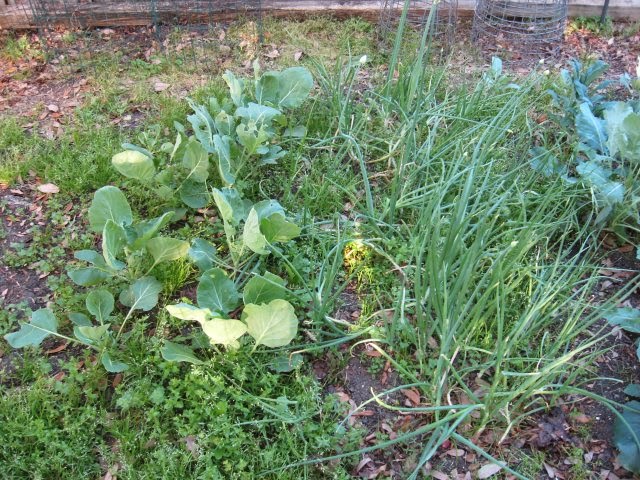 Then this is the end of the Crucifer patch with Brussels Sprouts. The Green Onions are here also because they grow best in cool weather, then as they get harvested I'll plant something else that does well in the heat.
 Next I need to put in the Tomato cages, pull more weeds, and finish spreading the mulch around. In a few weeks it will start looking like my garden should. The Sage is probably the best looking right now with its purple blossoms. I am already harvesting some things like Kale leaves, and green Onions. I am really looking forward to trying the Heirloom Tomatoes. Shouldn't be long now...
Here at the South end I have the Better Bush II, and Heirloom Tomatoes, along with the Serrano Chiles.
Then there is a patch of Herbs. I have three varieties of Sage, Rosemary, Lavender, Cilantro, and Parsley.
This is the Hot Chile patch with the Bhut Jolokias, Habaneros, and Cayenne Chiles. Mui Caliente...
Subscribe to:
Posts (Atom)