Sunday, February 16, 2014

Baby Tomatoes

I've been growing Tomatoes for around 15 years.  Spent a long time observing Tomato behavior.  There are a lot of Tomatoes around, sometimes for long periods of time.  When a Tomato has been ripe for a long time, several weeks, and is exposed to the right conditions, it's seeds will sprout, and begin growing inside the Tomato.  This one has been sitting in a South facing Kitchen window for a few weeks.
The temperature is around 70F all the time, and the window gets sun from mid to late afternoon.  So the conditions are good for seed germination.  You will first notice dark bumps under the skin of the Tomato.  Then the dark bumps move slowly, as the stem of the baby Tomatoes pushes the first leaves, the dark bump, outward.  At this point the Baby Tomatoes are breaking out of their egg.
I used a sharp knife to remove the skin, exposing the Baby Tomatoes.  The seed cavities are beneath the meat of the Tomato, and the sprouts have grown through the meat.  Next I'll tear the Tomato meat apart to extract the Baby Tomatoes being very careful not to damage the sprouts.
This Tomato yielded about 35 sprouts.  The green end is the first leaves, the dark bumps.  The red end is the albumen, analogous to an egg white, which is a nutrient sack meant to feed the young seedling until it can be planted in the ground.  I really expected to break more of the sprouts believing they would be more feeble, but they have that sprout zeal, and I only broke a couple.

 I prepared some cups with some potting soil for the Baby Tomatoes.  The cups are mostly full.  Carefully set the Baby Tomatoes on top of the soil, and cover with another quarter inch of the same soil.  The bottom of the cups have been pierced for drainage.
Then the cups will go in the South facing greenhouse window.  They will get good light from mid morning to mid afternoon.  The leaves should emerge from the soil in a couple days.  It will be about a month before I can plant them in the ground, and I think that should be enough time for them to get a good root base.
The next morning I thought I might as well start some Jalapenos as well.  There is a ripe Jalapeno in the Kitchen window, got cups, got soil, but these seeds aren't sprouted.  Otherwise its the same as with the Baby Tomatoes.  Pierce the bottom of the cups.  Fill them with soil.  Add a few Jalapeno seeds.  Cover with a small amount of the same soil, and water.
Last night I had some critter get into one of the Baby Tomato cups, and tump it over.  I added a rail to help keep the cups upright when curious critters are nosing around.  So it looks like my Summer Annuals are started.  I need to find some other plants to start like this.  Habaneros...

Friday, February 14, 2014

Winter Garden 2

Its been about a month since I planted seeds in the Winter Garden.  There are little sprouts in those areas.  Most of them are Crucifers, so all their sprouts look alike.  We finally had a couple warm days here where I can get out there, pull weeds, and plant some more early Spring vegetables.
This time I added some white and red Onions, green and purple Kohlrabi, Lacinato Kale, more green Cabbage, and Brussels Sprouts.  I've been using my compost from last year to cover mud spots, as I pull weeds, then the compost gets tilled in to improve the soil, and covered again.  Places where there are sprouts are just bare soil right now.  As the plants get bigger I will mulch around them.
This is the South side of the greenhouse.  This area is next to get cleaned up.  Here I have Rosemary, Oregano, and Thyme, which are all Evergreens.  In the middle of the long box is Tarragon, which is perennial, and it will start to grow in about a month when there is more light and warmth.
This is the view from the North side of the greenhouse.  In the middle are Sage, Rosemary, and Lavender, also Evergreens.  There are some Turnips that lasted through the Winter, but they don't look very good.  The greatest amount of green here are weeds, especially Clover.  I had sprinkled Carrot seeds all over the place and there are a lot of Carrots. These Winter Vegetables will mature and get picked around the time I plant Tomatoes, and Chiles in mid to late March.  As soon as the threat of frost is passed it is time to plant the Summer Annuals.  That is when I will do a deep Till, add plenty of compost to the soil, and supplement with Yum Yum Mix, an organic fertilizer.

Thursday, February 6, 2014

Fried Chicken Noodle Soup

It's 19 degrees outside right now.  I need a hearty food to keep me warm while I am working.  Thinking, comfort food, hmmm, Fried Chicken?  But also wanting soup, and crusty sourdough bread.  So I hatched a plan to put them together, and that is what this is...
Fried Chicken Noodle Soup is just that, Fried Chicken combined with Chicken Noodle Soup.  The Sourdough Bread is something I have been working on lately.  I've been improving my Pizza Doh processes to make a better Sourdough taste.  Then also there are the Chincharrones con Pollo, the crispy strips of Chicken skin used as a soup cracker, like fried Wontons, but Fried Chicken.  Uhhh...
Start with a one pound package of Chicken Thighs, bone in, skin on.  Just regular Chicken.  I use Tony Chachere's and Black Pepper to season , and flavor the Chicken.  You can use any spice mix you like for Chicken, but avoid using mixes with sugar, which will burn during the frying process.
I am going to fry these Chickens in one tablespoon of Pork Fat.  You don't need a lot of fat to fry something.  You only need enough to boil off the water, and maintain a dry cooking process.  Oil is a liquid, but it is not wet.  Water is wet, oil is dry.  With an oil frying process most of the water is immediately evaporated, and the result is dryer, more concentrated flavors.
Heat the pan, and oil until they are hot, but not smoking hot.  The oil will ripple when its hot.  Then place the Chicken in the pan skin side down.  Let them go, untouched, for ten minutes.  This is the part where we are making the nice crispy skin.
Next flip the Chicken over to brown the other side for another ten minutes.  You can see the nicely browned skin now.  That is what will become the Chincharrone con Pollo, or Fried Chicken Soup Cracker, mmmm.
To finish the Fried Chicken, in the oven safe pan, into the oven to let it cook through for another twenty minutes at 375F.  This will let the heat get down to the bones of the Chicken.  It is also melting the Chicken Fat, and making what is called Schmaltz, AKA melted Chicken Fat.  We'll use the Schmaltz to make the Roux for the Soup.
Classic Chicken Noodle Soup requires Mir Poix, which is Carrot, Celery, and Onion small diced.  This is Classic French Cooking, and the Mir Poix is a staple vegetable mix.  I'm only making a couple cups of Soup, so I'll only use one Carrot, two Celery heart stalks, and the end of a Mayan Sweet Onion.
The Chicken is done now, and the Sourdough Bread is in the proofing box.  Remove the Chicken from the pan to let it rest on a plate.  What is left in the pan is called the Fond.  The Fond is a mixture of the Pork Fat used for the Frying Process, the Schmaltz which melted away from the Chicken, small bits of the spice mixture, and Chicken bits that are left in the pan.  The Fond is a very flavorful mixture, and we'll use it to make the base of the Soup.
The Mir Poix is now diced, and the Chicken is resting.  Time to start the Soup.
There is more fat in the pan than we need so I remove the fat while trying not to remove the solids.  I need a couple tablespoons of fat left in the pan to saute the Mir Poix, and then build the Roux.
The Mir Poix goes into the Fond to saute over medium low heat.  We don't want to fry the vegetables.  This is also hydrating the Spice, and Chicken bits that are left in the Fond, expanding the flavor.  This is where real soup is different that those quick soups.  The fat is used, and combined with flour to make the Roux.  They call it Soup Base for a reason.  The Fond makes it real soup.
While the Mir Poix is sauteing, add the seasoning , and flavoring.  I added Sea Salt, Black Pepper, and dried Oregano.  Again, the seasoning, and flavoring are a matter of taste, and you can add what you like.  Then I added about two tablespoons of flour to transform the Fond into a Roux.  The flour will soak up the fat, and together they will thicken the soup base.  This is the solid hearty soup base I needed for the cold day...
I added two cups of Chicken Stock, and let the mixture come up to a simmer.  As the mixture begins simmering it will start to thicken.  If the mixture gets too thick, add a little water to thin it out.
OK, back to the Chicken.  I removed the skins from the Chicken, sliced them into strips, and put them in a baking pan to finish them.  The Chicken meat gets pulled off the bone, and roughly diced for the Soup.  The Chincharrone con Pollo get baked in the oven for another five minutes to crisp them up.
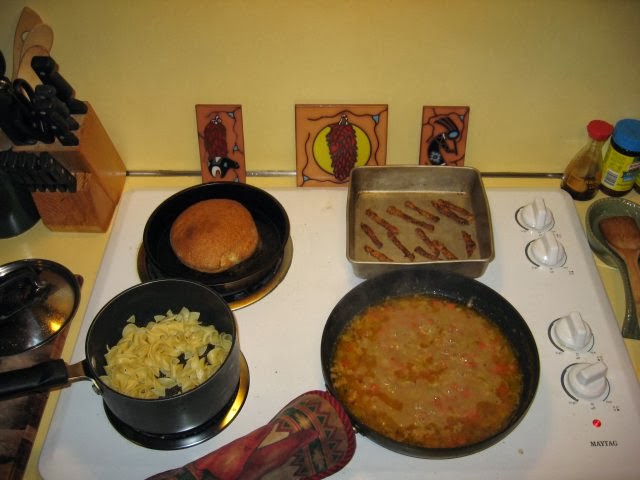
The Sourdough is done cooking.  I prepared about 1.5 dry cups of Egg Noodles for the Soup, they just finished.  The Chincharrone con Pollo just came out of the oven.  Time to Assemble the Fried Chicken Noodle Soup.
Noodles go into the Soup.
Chicken goes into the Soup.
Mix well, add to bowl.  Chincharrone con Pollo on the side, with crusty sourdough bread...

Tuesday, January 28, 2014

CaJohn's Execution Station

We went to Zestfest 2014 Sunday to experience the hottest Chiles in the World. There were a number of really hot Chile sauce vendors there this year. The vendors that were the most memorable are also the ones that had the hottest sauce. Grinders had their four sauces Whimpy, Molten, Near Death, and Death Nectar. The last one, Death Nectar was over the top for me at 377,000 Scovilles. I had to go sit down and recover. The one that really put the burn on me was CaJohn's Execution Station.   It started at 375,000 Scovilles and went to 6.1 Million Scovilles.
 
CaJohn's Execution Station was designed to understand the Chiles they use in their sauce.  Each stage of the Execution Station had a Chile Puree starting with Red Savina Habanero (375,000 Scovilles), Fatali (425,000 Scovilles), Chocolate Habanero (600,00 Scovilles), Yellow Morunga (800,000 Scovilles), Trinidad Morunga Scorpion (1.2 Million Scovilles), Carolina Reaper (1.6 Million Scovilles), and ended with their Black Mamba Sauce (6.1 Million Scovilles).  Between each stage we had to wait to let each Chile kick in.  Also there is no food allowed to dilute the sauces.  The whole challenge lasted 10 minutes, excruciating.
This was by far the hottest challenge there was this year at Zestfest.  After it was over I made a B Line to the concessions booth and got a large Dr. Pepper, and ate a whole bunch of plain Tortilla Chips.  It took a while to recover from CaJohn's Execution Station.

Monday, January 20, 2014

Southwestern Cabbage Rolls

I've had Stuffed Cabbage on my mind for a while now, and have been looking for a way to make it my own.  I had a need to make something unique, with my Southwestern flair, and always have superior nutrition in mind.  So I hatched a plan to make something akin to Enchiladas, but with Cabbage as the wrapper instead of Tortillas.  It has to have the Southwestern flavors like Red/Green Chile, Masa, Cumin, and Garlic.
It's Sunday, so there has to be that fancy Sunday Dinner feel also.  This dish took three hours to cook, so, yeah, it does have that Big Sunday Dinner feel to me, the cook, but also has extraordinary deliciousness that comes from the carefully thought out and prepared food.  This is probably close to Holiday food, although my family would never touch something like this.
A big head of green Cabbage is the focal point here.  Probably my favorite vegetable right now.  I've been eating some form of cabbage every day.  When the Cabbage is raw it is rather crispy, and tends to break when you try and roll it.  So, there is a need to make it mode pliable, so we'll steam it.  We'll remove the core of the cabbage, not just to facilitate the steaming process, but also so it fits in the steamer.
There is a stem in the middle of the steamer basket which I have to work around.  Also the Cabbage has to fit into the steamer, so I needed to trim the bottom of the Cabbage so that it would actually fit into the steamer.  This helps the peeling process later by detaching the bottom of the Cabbage leaves from the stem.
We'll let the Cabbage steam for several minutes to loosen the outer leaves.  As the leaves become pliable we'll peel them off, and let the inner leaves steam a little more.  As this process goes on I'm going to peel off all of the outer leaves until we get to the part of the Cabbage where the leaves start to interlock.  This yielded around ten large leaves which are suitable for stuffing.  The remainder of the core I save for another dish.
While I am waiting for the Cabbage to steam, I'll begin prepping the stuff for the filling.  I'm going to use half of a sharp white Onion, diced, a whole head of Garlic, diced, and two mild Anaheim Chiles, large diced.  I'll removed the Calyx, Seeds, and Membranes from the Chiles.
Now the Cabbage leaves are prepared, and I'm ready to start preparing the filling for the Cabbage Rolls.  I'm going to let the skillet heat up a while first so the cooking starts when I add the food to the pan.
The first thing to hit the pan is a pound of 73/27 ground Beef.  I am using a higher fat content ground Beef on purpose, for flavor.  Also this is a Sunday Dinner, it needs to be hearty, and satisfying, justifying the higher fat content.  The fat helps distribute the Chile flavor, and we will add some other components to the filling to contain the fat so the end product is not greasy.  Fat is actually something you need, and not bad for you.
As the Beef is browning I'll add the vegetative components so that the flavors of the Onion, Garlic, and Chile get infused into the Beef.  Salt the Beef during the browning process with Sea Salt.  The seasoning is where the flavor is, and Salt is the only seasoning, anything else is flavoring.
I add small amounts of Masa to the mixture as it is cooking to soak up the Fat, and the Water produced by the vegetables.  This produces a Maise Roux which thickens the mixture.  It also adds that Southwestern flavor.  We want to capture the Fat, and the Vegetable Water for nutritional purposes, all great stuff.
When the Beef is mostly browned we'll add additional flavoring.  Freshly cracked Black Pepper, Red Chile Flakes, Cumin, and more Sea Salt will bring this filling to the Apex of Southwestern Nomlishousness...
Then at the end of the filling preparation I am going to add the Stuffing part, a half cup of Black Rice, and a half cup of White Rice.  This is the filler part which puffs up our stuffing for the Cabbage Rolls.  You want the stuffing to have substance, and the Rice component adds some actual nutrition, unlike white bread.
Now we have the wrappers, and the stuffing finished, and we are going to move on to work on the Sauce.  Most Stuffed Cabbage has a plain Tomato Sauce to top it,, but here we are going to make a Southwestern Sauce to kick these Southwestern Cabbage Rolls up to the status of Sunday Dinner.
I always start my Tomato Sauces with a can of Whole Tomatoes, and Sea Salt.  This time I am adding Garlic Powder, Red Chile Flakes, Cumin, and a whole Jalapeno.  I'll put all these ingredients in the food processor and process them until I get a smooth mixture.
The Cumin makes it Southwestern more that anything, and I find that I really love the mixture of Red and Green Chile in a sauce.  The Sauce is going to to help meld all the flavors into something unique.
Transfer the Southwestern Sauce to a bowl, and then add a can on Tomato sauce to it, because we need the volume of sauce.  We are filling a 13x9 Casserole with the Southwestern Cabbage Rolls, and we are going to need lots of sauce.  The Tomato sauce will dilute the Southwestern Sauce a little, but it's OK, cooking will concentrate the flavors.
OK, now we are ready to assemble the Southwestern Cabbage Rolls.  I'm going to setup a station where everything is in close proximity for easy access.  I am going to cover the bottom of the Casserole dish with the Southwestern sauce.  Then stage a Cabbage leaf for the filling.
Add a couple of tablespoons of the filling to the bottom of the Cabbage leaf, and spoon in a little of the Southwestern sauce.  Roll the bottom of the Cabbage leaf over the filling, fold in the sides, and then finish rolling the Cabbage leaf.  This is very much like rolling Egg Rolls, or Burritos, just make a nice little package for the stuffing, and continue until the Casserole dish is filled with Nomlishous Cabbage Rolls.
I've probably used about half of the Southwestern Sauce filling the Cabbage Rolls.  You can see the Casserole dish is fully occupied.  Now we'll add the rest of the Southwestern Sauce to cover the Cabbage Rolls.  We want the sauce to go at the Cabbage rolls from all sides, first to keep the Cabbage hydrated in the oven, and also to infuse the Cabbage with the Nomlishous Southwestern Sauce.
Next we are going to place the Southwestern Cabbage Rolls in a slow oven (350F) for about 30 minutes, just to reheat everything.  All the components are already cooked, so there is no need to cook them again.  We just need to reheat them a while, and allow the flavors to meld together.
After cooking you can see he mixture has dehydrated a bit.  The Southwestern Sauce has permeated the Cabbage Rolls, and made them totally nomlishous.  Now that I am done with the cooking I can watch the last two minutes of the Championship Game, LOL!